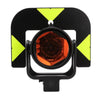
The perfect partner for a total station: a 360-degree prism, redefining "rapid surveying"
In modern engineering surveying, construction, and mining mapping, the accuracy and efficiency of a total station directly determine the project's progress and quality. To maximize the total station's potential, choosing a suitable reflecting prism is crucial. The 360-degree prism is a revolutionary tool designed for this purpose. Unlike traditional single-sided prisms that require cumbersome manual alignment, the 360-degree prism achieves omnidirectional, blind-spot-free signal reflection. No matter where the prism is pointed, the total station can instantly capture and lock onto the target.
360-degree prism redefining "rapid surveying"
In traditional surveying, operators must constantly keep the prism face directly facing the total station; even slight deviation leads to signal loss and requires re-aiming. This not only slows down the process but also becomes exhausting in scenarios involving movement and complex terrain. The 360 Degree Prism achieves 360° horizontal and large-angle vertical reflection coverage through its unique spherical or conical arrangement of reflective units. The following three core features are key to its redefinition of "rapid surveying":

1. Omnidirectional Reflection: No "Aiming" Required, Measure Immediately After Placement
Traditional single-prism surveyors require constant adjustments to the prism's orientation, much like a sniper. The 360 Degree Prism completely eliminates this constraint. Whether the prism is raised, lowered, or rotated, the total station receives a stable echo signal. This means a single person can complete surveying tasks that previously required two people working together—the prism operator no longer needs to focus on aiming, but can quickly move to the next measurement point; the instrument operator continuously collects data with zero waiting time. This "blind surveying" capability increases the efficiency of a single station by more than 50%.
2. Rapid Acquisition: Real-time Tracking of Dynamic Targets
In scenarios requiring continuous mobile measurements, such as road layout, slope monitoring, or building facade scanning, the 360 Degree Prism demonstrates unparalleled advantages. Because the signal reflecting surface always faces the total station, the instrument can continuously lock onto the moving prism at the highest frequency, enabling "measurement while moving." Combined with the automatic tracking function of modern total stations, surveying teams can complete data acquisition for linear engineering at walking speed, eliminating the discontinuous "stop-align-measure-move-stop" pattern. Rapid mapping is no longer a slogan, but a reality with coordinate updates several times per second.
3. High Reliability: Reduced Human Error, More Stable Data In traditional single-prism operations, if the mirror is not precisely aligned, not only will distance measurement fail, but eccentricity errors may also occur. The multi-faceted reflection design of the 360 Degree Prism ensures the uniformity of signal strength; regardless of changes in the incident angle, the reflection center remains stable at the geometric center of the prism. This significantly reduces systematic errors caused by operating habits, fatigue, or terrain limitations, resulting in extremely high consistency in repeatability. For control surveys or deformation monitoring requiring millimeter-level accuracy, this stability itself is the best guarantee of "speed"—because you don't need to repeatedly remeasure.
Key Considerations When Purchasing a 360 Degree Prism
There are many types of 360 Degree Prisms on the market, with prices ranging from tens to thousands of yuan. To ensure a perfect match with your total station and truly achieve rapid surveying, please pay close attention to the following four technical details when purchasing:
Accuracy Class: Choose a Constant Matching Project Requirements
The prism constant of the 360 Degree Prism (usually 0mm or +30mm, etc.) must be consistent with the built-in parameters of the total station. For high-precision engineering surveys (such as bridges and tunnels), a rigorously calibrated zero-constant prism should be selected, with a prism error within ±1mm. For general topographic surveying or setting out, a standard accuracy of ±3mm is acceptable. Always request the manufacturer's factory inspection report before purchasing.

Reflective Material and Weather Resistance
High-quality prisms use coated optical glass, offering high reflectivity and resistance to aging. The shell material determines the lifespan for field operations—construction sites often experience impacts from sand and gravel and immersion in rainwater. We recommend choosing models with an IP67 or higher protection rating and an engineering plastic or aluminum alloy casing. Also, check that the prism window has a hard coating to prevent scratches that could cause signal attenuation.
Center Rod and Adapter Compatibility
Different brands of total stations (such as Leica, Trimble, Topcon, and Southern Surveying) may use different threaded interfaces (5/8 inch or 11mm). Ensure the 360 Degree Prism's base can securely connect to your existing center rod or bracket, and that the locking mechanism is not easily loosened. Some prisms also support quick-change adapters for greater flexibility.
Working Distance and Reflection Range
Define your typical distance measurement range: short distances (<500m) can be achieved with a standard prism; medium to long distances (500-1500m) require models with a larger reflective area. Additionally, pay attention to the prism's effective vertical angle—some inexpensive products experience a sharp signal drop when tilted beyond ±20°, making them unsuitable for areas with large elevation differences. Reputable manufacturers will provide a complete reflection direction diagram; please check it carefully.

In summary
The 360 Degree Prism, through its omnidirectional reflection, ultra-fast acquisition, and high reliability, completely liberates the operation of total stations, making "rapid surveying" a reality. Focusing on accuracy, materials, compatibility, and working distance when purchasing will yield a significantly better experience.
As a professional manufacturer of surveying accessories, SMTOER offers a long-term supply of various models and accuracy levels of the 360 Degree Prism, covering engineering standard, high-precision monitoring, and ultra-long-distance reflective types, compatible with mainstream total station brands. Contact us now for a product catalog and one-on-one selection advice—let your team enjoy true "instant" efficiency from your next field trip!