How to Choose the Right Survey Prism Pole for Accurate Land Surveying?
In the world of land surveying, precision is everything. Every distance, angle, and elevation measurement your total station records depends on a clean line of sight and a perfectly stable reflector position. That’s where the survey prism pole comes in. It keeps your prism at a defined height, aligned, and steady, allowing the instrument to measure with confidence.
A poorly chosen or improperly set up prism pole can introduce errors that compromise your entire survey. A centimeter of error at the pole translates to a centimeter of error—or more—in your final data. Whether you’re performing boundary surveys, topographic data collection, or construction staking, choosing the right surveying prism pole is a decision that directly affects the accuracy of your measurements.
Understanding the Survey Prism Pole: The Foundation of Accurate Measurements
A prism pole for total station is a graduated pole used to hold a surveying prism, target, or reflector at a known height above a point on the ground. When paired with a total station or compatible measuring instrument, the prism pole allows surveyors to capture precise distance, angle, elevation, and coordinate measurements.
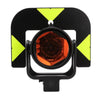
The basic components of a surveying prism pole include the base (or tip), pole sections, and the prism mount. The base provides stability during measurements. The pole sections allow height adjustment based on field conditions or the instruments you’re using. The prism on top reflects signals back to surveying instruments, enabling accurate distance calculation.

Key Factors to Consider When Choosing a Survey Prism Pole
1. Material: Aluminum, Fiberglass, or Carbon Fiber?
The material of your adjustable prism pole is one of the most critical decisions you’ll make. Each option offers different advantages depending on your work environment and accuracy requirements.
Aluminum Prism Poles: The Cost-Effective Workhorse
Aluminum poles are a cost-effective and dependable choice for everyday surveying and construction layout. They’re lightweight, easy to transport, and a practical option for most crews. However, aluminum poles are slightly heavier than carbon fiber and prone to dents.
Fiberglass Prism Poles: Durability and Electrical Insulation
Fiberglass poles are built for durability and added strength in demanding field conditions. They offer excellent electrical insulation—essential when working near power lines—and are temperature-resistant. The trade-off is increased weight compared to aluminum or carbon fiber.
Carbon Fiber Prism Poles: The Professional’s Choice
Carbon fiber prism poles are a popular choice for professionals who want a lightweight pole without sacrificing durability. Carbon fiber offers excellent rigidity while remaining lightweight, which helps reduce flex and improves stability during observations. A typical 2-meter carbon fiber pole weighs approximately 0.9kg, while aluminum alternatives can be 30–40% heavier. This weight reduction significantly reduces operator fatigue during long field sessions.
Carbon fiber poles are resistant to corrosion, temperature changes, and moisture, making them ideal for high-precision RTK work. They are, however, the most expensive option and can be sensitive to point impacts.
2. Height: Fixed-Height vs. Adjustable Prism Poles
Prism poles are commonly available in fixed-height and adjustable-height designs.
Fixed-Height Prism Poles are simple, reliable, and help reduce setup errors when working at the same prism height throughout a project. They’re commonly used for control surveys, monitoring projects, and applications where consistency between observations is critical.
Adjustable Prism Poles give crews more flexibility by allowing the pole height to be changed for different instruments, prisms, and job site requirements. Telescopic surveying prism poles are particularly versatile, with telescopic sections that can be extended or retracted to achieve the required height. Most surveyors prefer adjustable prism poles because they’re versatile and easier to use across multiple applications.
The most common prism pole sizes include 8.5-foot, 12-foot, and 15-foot models. The primary factor in choosing your survey prism pole height is the specific requirements of your surveying task and the surrounding terrain.

3. Locking Mechanism: Keeping Your Pole Secure
A dependable locking mechanism is essential for maintaining height stability during measurements. Telescopic prism poles rely on various locking systems to secure pole sections at the desired height.
Twist-Lock Systems are common and provide easy, secure tightening. Some feature soft rubber knobs for easy adjustment, even with gloves.
Eccentric Clamps are more reliable than screw locks, especially in cold weather. They provide secure and stable height adjustment during use.
Quick-Release Systems can significantly improve field efficiency by allowing surveyors to change prisms, adapters, and accessories without repeatedly threading components on and off the pole.
Locking Pin Mechanisms with preset positions provide secure, repeatable setups.
When evaluating a telescopic aluminum or carbon fiber pole, always test the locking mechanism. If it slips even slightly, it can compromise your entire setup.
4. Prism Compatibility and Thread Specifications
Before purchasing a prism pole for land surveying, verify that it’s compatible with your existing equipment. Most professional prism poles are designed around standard survey threading and mounting systems.
The industry standard is the 5/8″ x 11 thread. When evaluating a prism pole for GPS GNSS RTK total station compatibility, always verify the thread specifications before purchasing. Some poles also feature 3/8″-16 threading at the bottom for attaching bipods, tribrachs, or extension poles.
5. Graduations and Measurement Markings
Clear measurement markings on your surveying rod are essential for easy height reference. Quality prism poles feature dual graduations (feet and metric) for versatile field use. The graduations should be easy to read in various lighting conditions, with alternating red and white bands for enhanced visibility.
6. Bubble Level and Plumbness
A built-in bubble level (vial) is critical for keeping the survey prism pole perfectly vertical. Most surveying prism poles come with level vials. Before using a level vial, you must ensure it is calibrated. Circular vials typically have sensitivity in the range of 30 to 60 arc-minutes.
To plumb your pole, extend it to the desired height, lock it in place, and adjust until the bubbles are centered. Hold the pole vertical using the bullseye level.
Types of Survey Prism Poles for Different Applications
Standard Prism Poles
Standard prism poles are the most common type, used with total stations for general surveying tasks. They’re available in various materials and height configurations.
Robotic Prism Poles
Robotic prism poles are designed for use with robotic total stations. These poles often feature carbon fiber construction and are graduated to read direct for specific prism heights, such as the 135 mm Trimble standard prism height.
Mini Prism Poles
Mini prism poles are compact, high-precision solutions designed for stakeout, alignment, and short-range surveying applications. They’re ideal for close-range work and tight spaces.
GNSS/RTK Poles
GNSS poles or RTK poles are designed to hold GNSS receivers and are often made from carbon fiber for maximum rigidity and minimal deflection under equipment weight.
Common Applications of Survey Prism Poles
Prism poles are essential tools for a wide range of surveying applications:
Construction staking – establishing precise points for building and infrastructure projects
Boundary surveys – defining property lines and legal boundaries
Topographic surveys – mapping terrain features and elevations
Control points – establishing reference points for coordinate systems
Grading work – measuring and verifying slopes and elevations
Layout applications – setting out positions for construction elements

Buying a Survey Prism Pole: What to Look For
When you’re ready to purchase a survey prism pole, keep these essential considerations in mind:
1. Assess Your Specific Needs
Start by evaluating the type of surveying work you do most often. Are you performing daily construction layout, or do you specialize in high-precision control surveys? The answers will guide your material and configuration choices.
2. Set a Realistic Budget
Carbon fiber prism poles offer the best performance but come at a premium price. Aluminum poles are more budget-friendly and perfectly suitable for many applications. Balance your budget against your accuracy requirements and frequency of use.
3. Check Compatibility
Verify that the survey prism pole you’re considering is compatible with your total station, prism, and other accessories. Most poles use the standard 5/8″ x 11 thread, but always double-check before purchasing.
4. Test the Locking Mechanism
If possible, test the pole’s locking mechanism before buying. It should feel firm and secure, with no slipping or play when extended. Eccentric clamps are generally more reliable than screw locks, especially in cold weather.
5. Consider Portability
If you frequently move between job sites, a telescopic carbon fiber pole that collapses to a compact size will be easier to transport and store. Weight is also a crucial factor—lighter poles reduce operator fatigue during long field days.
6. Look for Quality Graduations
Ensure the pole has clear, durable graduations that are easy to read in various lighting conditions. Dual graduations (feet and metric) provide maximum versatility.
7. Inspect the Bubble Level
Check that the bubble level is accurate and properly calibrated. Some poles feature 40-minute adjustable vials for enhanced precision.
8. Consider Accessories
Think about the accessories you might need, such as bipods for stability, prism adapters, or carrying bags. Some prism poles come as complete kits with these accessories included.

Frequently Asked Questions About Survey Prism Poles
Q1: How does a prism pole work?
A prism pole features a bracket that attaches prisms and other targets to the top of the pole for distance measurement. The prism reflects signals back to the total station, which calculates distance based on the time it takes for the beam to return. The pole’s graduations and alternating red and white bands also allow it to be used with optical levels for measuring elevations and grades.
Q2: How do I plumb a prism pole?
Most surveying prism poles come with level vials. Before using a level vial, ensure it is calibrated. After checking calibration, extend the pole to your preferred height, lock it in place, and adjust until the bubbles are centered. Hold the pole vertical using the bullseye level.
Q3: How do I calibrate a prism pole’s vial?
To calibrate a prism pole vial: find a doorframe with a top jamb and a sill, drill a small hole into the top jamb, use a plumb bob to find a point in the sill directly below the hole, place the prism pole tip in the sill’s hole, extend the pole until its top fits into the top jamb’s hole and lock it in place, turn the vial’s adjustment screws until the bubble is centered, then rotate the pole to check if the bubble remains centered. Alternatively, use a dedicated calibration tool like the SECO Pole Peg Adjusting Jig.
Q4: What is the difference between fixed-height and adjustable prism poles?
Fixed-height prism poles are simple and reliable, eliminating setup variability and reducing the risk of recording incorrect pole heights. They’re ideal for control surveys and applications where consistency is critical. Adjustable prism poles (telescopic) offer flexibility by allowing the pole height to be changed for different instruments, prisms, and job site requirements.
Q5: Which material is best for a prism pole?
It depends on your needs. Carbon fiber prism poles offer the best strength-to-weight ratio, making them ideal for high-precision work and long field days. Aluminum prism poles are cost-effective and dependable for everyday surveying. Fiberglass prism poles provide durability and electrical insulation for demanding conditions.
Q6: What thread size do most prism poles use?
The industry standard for prism poles is the 5/8″ x 11 thread. Most professional prism poles are designed around this standard threading and mounting system, allowing compatibility with a wide range of prisms, adapters, and total station equipment.
Q7: How do I maintain my prism pole?
Regular maintenance extends the life of your survey prism pole: clean the pole after each use with a soft cloth and mild detergent, especially if used in muddy or dusty conditions; frequently inspect for damage or wear, especially at joints and locking mechanisms; and store the pole in a dry, secure location to prevent damage from moisture or accidental impacts.
Q8: Can I use a prism pole with GPS/GNSS equipment?
Yes. Many prism poles are designed for use with both total stations and GNSS/RTK equipment. GNSS poles or RTK poles are specifically designed to hold GNSS receivers and feature carbon fiber construction for maximum rigidity and minimal deflection under equipment weight.