Why GPS Survey Poles Are Essential for Accurate GNSS and RTK Surveying?
The Foundation of Precision in Modern Surveying
In the world of land surveying, construction layout, and geospatial data collection, precision is everything. Yet one of the most overlooked pieces of equipment is the GPS survey pole itself. A surveying pole—also called a geodetic pole or RTK pole—is one of the most essential tools in land surveying. It may look simple, but in practice, it acts as an extension of your arm, holding a GNSS receiver or prism and allowing you to position your surveying equipment precisely in space.
The quality of your GPS survey pole directly impacts every measurement you take. A reliable surveying pole is the foundation of precision in geodetic work—it affects the accuracy of your GNSS or total station measurements, the speed of your tasks, and the overall reliability of your field data.
How GPS Survey Poles Impact GNSS and RTK Accuracy?
The Critical Link Between Antenna and Ground Point
The GPS survey pole serves as the physical link between your GNSS antenna and the ground point being measured. A typical RTK survey instrument is a two-meter-high pole with a GNSS receiver at the top and a spike at the bottom. The instrument is placed vertically on the target point, and its position is obtained by reducing the offset between the antenna phase center and the pole tip.
When using RTK positioning, the rover pole must maintain a perfectly vertical orientation to ensure accurate coordinates. Any deviation—whether from poor pole construction, loose locking mechanisms, or operator error—introduces measurement errors that can compromise your entire survey.
Understanding Survey-Grade vs. Standard Equipment
Survey-grade GNSS receivers perform significantly better than recreational or standard-grade equipment, with median horizontal distance estimates of 0.5–1.1 meters compared to 3–7 meters for recreational-grade units. However, even the most advanced survey-grade GPS receiver cannot deliver accurate results without a properly constructed GPS survey pole.
The rover pole itself must be considered part of the accuracy equation. Studies evaluating the relationship between ranging pole support and RTK-GNSS position solution quality indicate that how the RTK range pole is supported directly affects positioning accuracy. This is why professional surveyors invest in high-quality survey poles rather than settling for inexpensive alternatives.

Types of GPS Survey Poles: Choosing the Right Tool for Your Workflow
By Material: Finding the Balance Between Strength, Weight, and Durability
Carbon Fiber GPS Survey Poles: Precision and Lightweight Performance
Carbon fiber survey poles offer maximum rigidity with minimal deflection under equipment weight—especially important for GNSS surveying. A typical 2-meter carbon fiber GPS pole weighs approximately 0.9 kg, compared to aluminum alternatives that can be 30–40% heavier. This weight reduction significantly reduces operator fatigue during long field days.
Carbon fiber is also resistant to corrosion, temperature changes, and moisture, making it ideal for high-precision RTK work in challenging environments. The downside? Carbon fiber is the most expensive option and is sensitive to point impacts—a hard drop can cause cracking rather than denting.
Aluminum GPS Poles: The Reliable Workhorse
An aluminum GPS pole offers the best balance of strength, rigidity, and affordability. While carbon fiber is lighter, it costs significantly more and can be fragile under impact. Fiberglass is durable but heavier and less rigid. Aluminum strikes the sweet spot—corrosion-resistant, sturdy enough for rugged job sites, and budget-friendly without sacrificing accuracy.
A typical 2-meter aluminum pole weighs about 1.0–1.35 kg. Modern aluminum alloys have reduced the weight penalty while maintaining professional-grade performance. For most surveyors, the aluminum GPS pole is the reliable workhorse that performs day in and day out.
Fiberglass Survey Poles: Lightweight and Electrically Insulated
Fiberglass poles are very light, non-conductive (essential near power lines), and corrosion-free. However, they are less rigid than carbon or aluminum, with more deflection under heavy receivers and less durability under heavy use. Fiberglass is best suited for applications where low weight and electrical insulation matter more than rigidity.

By Design: Transport and Ease of Use
Telescopic Surveying Poles: Flexible and Portable
Telescopic surveying poles are compact when collapsed (easy to transport) and offer quick height adjustment. Reliable locks—especially eccentric (cam-style) clamps—are preferred in cold weather.
Telescopic poles are ideal for urban surveying, RTK GNSS fieldwork, and mobile teams who move frequently between sites.
The downside? Telescopic poles are slightly less rigid than sectional poles and require proper clamp maintenance.
Sectional Surveying Poles: Stable and Durable
Sectional surveying poles offer high rigidity, are easy to maintain, and remain compact when disassembled. They are suitable for longer projects where stability matters more than deployment speed—though they are slower to set up and dismantle.
Fixed-Height RTK Poles: Simplicity and Consistency
Fixed-height poles work fine when you are always measuring from the same height and reduce setup errors because the height remains constant, making them popular for repeatable RTK workflows and control measurements.
Key Factors to Evaluate When Buying a GPS Survey Pole
When comparing GPS pole models, pay close attention to these critical aspects:
Weight and Portability
Choose a weight you can comfortably handle all day. Heavier poles cause fatigue over long sessions, but modern alloys and carbon fiber construction have significantly reduced the weight penalty. A carbon fiber GPS pole weighing under 1 kg can make a substantial difference during eight-hour field days across varied terrain.
Height Range and Adjustability
Most telescopic Aluminum GPS Pole models extend from 1.4 m to 2.5 m with preset locking positions (e.g., 1.6 m, 1.8 m, 2.0 m). Height choice between 1.80 and 2.00 meters can be a plus when doing very intense surveying. Ensure the range matches your typical measurement needs and that the pole has clear graduation markings.
Locking Mechanism Reliability
The clamp is the heart of the pole. Eccentric (cam-style) locks are more reliable than twist-locks, especially in cold or dusty conditions—they maintain consistent clamping force over time. Avoid cheap friction-only locks if you work in harsh environments. Compression and snap lock systems provide quick height adjustment while maintaining excellent rigidity for professional RTK surveying.

Thread Compatibility
Nearly all professional GPS poles use the 5/8″-11 TPI thread. Verify this matches your GNSS receiver, prism, or adapter. Some poles offer interchangeable tips for added versatility. Universal poles designed for compatibility with Trimble, Topcon, and other major RTK/GPS receiver systems typically feature this standard threading.
Built-in Leveling Bubble
A circular bubble level is essential to keep the pole perfectly vertical. Check that it is accurate and easy to read in bright sunlight. Some advanced poles now integrate IMU tilt compensation, allowing a GNSS receiver to accurately measure a ground point even when the survey pole is not perfectly vertical.
Tip Durability
Look for a replaceable steel point with a rubber protective cover. This extends the life of your GPS pole and allows quick tip changes when worn.
Calibration and Maintenance
A calibrated pole is non-negotiable for accurate measurements. When a survey pole is not properly calibrated, it systematically corrupts every data point you collect. RTK pole calibration has two components: the physical bubble check and the IMU calibration. Regularly check the connection parts and stability of the pole, avoid using it in extreme weather, and keep the pole clean to ensure optimal performance.
GPS Survey Pole vs. Prism Pole: Understanding the Difference
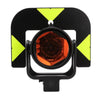
Rover poles are commonly used with GNSS receivers for RTK positioning, while prism poles are designed for total station measurements using prisms or targets. A prism pole is a specialized surveying tool designed to securely hold a prism reflector at a fixed height so it can be accurately targeted by a total station.
If you take a pole designed for a total station and use it with a GNSS receiver, you may get a height error of up to 14 cm because the side marks on the pole are higher than the real height. Always ensure your survey pole suits your specific equipment and application.
Frequently Asked Questions About GPS Survey Poles
Q1: What is a GPS survey pole?
A GPS survey pole (also called a geodetic pole or RTK pole) is a specialized pole used in land surveying to hold a GNSS receiver or prism at a precise height above a ground point. It ensures accurate positioning by maintaining a stable, vertical connection between the antenna and the measurement point.
Q2: Why does the material of a survey pole matter?
The material affects weight, rigidity, durability, and cost. Carbon fiber is lightest and most rigid but expensive and impact-sensitive. Aluminum offers the best balance of strength, rigidity, and affordability. Fiberglass is non-conductive and lightweight but less rigid.
Q3: Can I tilt the GPS survey pole while collecting data?
By surveying standards, you should always have the pole vertical while actually collecting coordinates with the rover. However, IMU tilt compensation technology now allows some GNSS receivers to accurately measure a ground point even when the pole is not perfectly vertical.
Q4: How do I calibrate my RTK survey pole?
RTK pole calibration has two components: the physical bubble check and the IMU calibration. Access the calibration settings on your device, select Antenna Parameters, choose Pole Height as the measuring type, enter your pole height, and follow the calibration procedure.
Q6: What thread size do most GPS survey poles use?
Nearly all professional GPS poles use the 5/8″-11 TPI thread. This is the industry standard and ensures compatibility with most GNSS receivers, prisms, and adapters.