A Leap in Precision: How Does the RT103 Reflective Target Reduce Measurement Error to New Lows?
When a laser beam hits a piece of highly reflective tape on a work uniform, the measurement data instantly deviates from expectations. Meanwhile, the RT103 reflective target maintains a stable signal, remaining perfectly still.
This is a recurring scenario in demanding industrial measurement environments, and the key difference often lies in the targeted object—the RT103 reflective target.
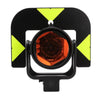
This component, designed specifically for high-precision photoelectric sensors and laser tracking systems, is redefining the standards of reliability and accuracy in measurement through its revolutionary technology.
Precision Challenges: The Core Pain Point of Modern Industrial
Measurement The world of industrial measurement has never ceased its pursuit of precision. From traditional engineering surveying to cutting-edge automated production lines and complex dynamic positioning systems, every measurement directly impacts the quality and safety of the final product.
In ship dynamic positioning, large robotic arm collaborative operations, or high-precision assembly lines, micron-level errors can lead to a chain of failures.
The fundamental challenge facing traditional measurement methods lies in environmental interference. Stray ambient light, reflective strips on work clothes, and occasional reflections from the metal surfaces of equipment can all be misinterpreted by sensors as target signals.
This "false reflection" problem forces operators to repeatedly confirm the target, leading to inefficiency and fundamentally limiting the reliability and accuracy of automated systems.

Working Principle: How RT103 Achieves an Error Revolution
The core of the RT103 reflective target lies in its "selective retroreflection" technology. Unlike ordinary reflective materials, it is designed to produce high-intensity, stable retroreflection only for specific wavelengths or coded light signals.
The ingenuity of this technology lies in its fundamental change to how sensors and targets "communicate."
Dual-wavelength recognition mechanism: Advanced RT103 reflective targets may employ methods similar to those in patented technologies, using two different wavelengths of light.
Intelligent signal filtering: The sensor emits a beam containing two wavelengths. The target's built-in precision optical structure (such as a specially designed dielectric mirror) selectively reflects one wavelength while reflecting almost nothing of the other.
Active Authentication: By analyzing the intensity ratio of the two wavelengths in the returned signal, the sensor can actively "identify" the genuine RT103 reflective target and decisively ignore interfering reflections from other objects (such as oil drums, glass, or worker clothing).
This process represents a qualitative leap in measurement, shifting from "passively receiving reflections" to "actively verifying targets," reducing systematic errors caused by target misjudgment to almost zero.
Three Pillars for Ultra-High Stability
The low-error performance of the RT103 reflective target is not the result of a single technology, but rather the synergistic effect of multiple precision designs.
Optical Design Pillar: Its internal optical path is precisely calculated and optimized through simulation to ensure that incident light returns to the sensor along its original path with maximum efficiency. This design guarantees that the intensity of the returned signal remains sufficiently stable and reliable even at greater distances or tilt angles.
Materials and Process Pillar: To cope with the extreme environments of industrial sites, the RT103 reflective target pursues excellence in materials and processes. It employs high-quality raw materials and coating technologies, giving it outstanding environmental resistance.

Wide Dynamic Range Support: To operate stably under complex lighting conditions, high-performance reflective targets require extremely high immunity to ambient light interference. Related data shows that similar high-standard devices can achieve an interference immunity level of up to 103dB.
This means it can clearly extract weak measurement signals from strong ambient light background noise, ensuring stable performance under strong indoor lighting or variable outdoor lighting conditions.
Purchase Guide: Finding the Right RT103 Reflective Target for You
Understanding the core parameters is paramount. You need to focus on its optical performance indicators, such as reflection efficiency, effective working distance, beam divergence angle compensation capability, and operating wavelength. Environmental adaptability is also crucial.
Identifying genuine products and their quality is key to avoiding pitfalls. Genuine products are usually impeccably crafted, with clear, professional labeling and packaging. Be wary of products priced significantly below market levels; these may use inferior materials or simplified processes in core optical components, leading to rapid performance degradation and measurement drift.
Evaluate the supplier's professionalism. A reputable RT103 reflective target manufacturer or supplier not only provides the product but also comprehensive technical support, including installation guidance, calibration advice, and compatibility consultation. It's important to ascertain whether the supplier possesses the relevant technical background and a reliable after-sales support system.
When measurements are no longer misled by interference, data gains a bridge across the chasm. The RT103 reflective target provides more than just a coordinate point; it is the cornerstone of trust connecting digital commands with precise actions in the physical world.