A Breakthrough for Tunnel Surveying: How 360-Degree Prisms Solve Focusing Challenges in Confined Spaces
In the field of engineering surveying, accurate data acquisition is the cornerstone of project success. Traditional surveying prisms perform well in open areas, but once surveyors enter confined spaces such as tunnels, mine shafts, or complex industrial structures, they face significant focusing and aiming challenges. The advent of 360-degree prisms is a revolutionary solution to this problem. This innovative 360-degree prism design allows for measurements from any horizontal direction, completely transforming the workflow in restricted environments.
Traditional Surveying Difficulties and Focusing Challenges in Confined Spaces
When conducting surveys inside tunnels, mines, or large buildings, space limitations present multiple obstacles. The placement of surveying instruments (such as total stations) is often restricted, making it difficult for operators to move to ideal survey stations. Traditional unidirectional or limited-angle prisms require the prism's front face to be roughly aligned with the instrument, which is extremely difficult to achieve in winding, dimly lit tunnels, leading to repeated adjustments, low efficiency, and even safety hazards.
360-Degree Prisms: Core Design Principles and Breakthroughs
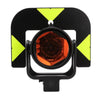
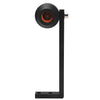
The ingenious design of the 360-degree prism lies in its cylindrical or polyhedral structure, with a continuous or segmented high-precision reflective film covering its surface. This means that regardless of the horizontal direction from which the total station's beam enters, the prism can accurately reflect the light back along its original path. This principle directly solves the fundamental problem of "focusing"—surveyors no longer need to painstakingly orient the prism's front face towards the instrument; they simply place the 360-degree prism at the target point and can take quick measurements from any visible position around it.
Outstanding Application Areas of 360-Degree Prisms
Tunnels and Underground Engineering
This is the most valuable application scenario for 360-degree prisms. In tunnel excavation, lining inspection, and deformation monitoring, surveyors can fix 360-degree prisms to the tunnel sidewalls or arch, and then conduct rapid, continuous monitoring from multiple survey stations behind them, significantly improving the efficiency and safety of breakthrough surveying and convergence measurements. Mine and Tunnel Surveying

In complex mine tunnel networks, the 360-degree prism allows for surveying multiple branches from tunnel intersections or main passages without frequently entering dangerous or difficult-to-access side tunnels, significantly reducing operational risks.
Large Industrial Facilities and Enclosed Structures
In spaces such as large storage tanks, ship hulls, steel structure workshops, or bridge box girders, measurement conditions are often restricted. Using the 360-degree prism, equipment installation and calibration, deformation monitoring, and completion acceptance measurements can be easily performed.
Automated Monitoring Systems
The 360-degree prism is an ideal target point in automated monitoring systems installed on landslides or building corners. The monitoring total station can track multiple prisms in different directions from a single fixed position, resulting in a more flexible and reliable system setup. When choosing a 360-degree prism suitable for your project, the following core factors should be considered:
Measurement Range and Accuracy: Confirm that the prism's effective reflection distance and nominal accuracy meet your instrument requirements (e.g., suitable for 0.5”, 1”, or 2” total stations). High-precision projects require high-quality 360-degree measuring prisms.
Structure and Environmental Adaptability: Choose a robust, waterproof, and dustproof model based on the operating environment. Prisms used in tunnels and mines need good impact resistance and dirt resistance.
Compatibility and Installation Method: Ensure that the prism's connecting rod or base is compatible with your existing centering rods, brackets, or forced centering devices. Convenient installation methods can improve field work efficiency.
Horizontal Angle Coverage: Confirm whether it provides true 360-degree omnidirectional reflection or segmented coverage (e.g., double-sided or four-sided). Omnidirectional types offer maximum flexibility.
Brand and Manufacturer: Choose a reputable professional 360-degree prism manufacturer. A technologically mature 360-degree prism manufacturer can not only provide high-quality products but also professional technical support and after-sales service.

Summary and Call to Action
In summary, the 360-degree prism, through its innovative omnidirectional reflection design, perfectly solves the core pain points of difficult focusing and limited station setup for measuring instruments in narrow and complex spaces such as tunnels. It improves measurement efficiency, data reliability, and operational safety, making it an indispensable tool in modern engineering surveying, especially in the field of underground engineering.
If you are looking for a solution to the measurement challenges of tunnels, mines, or complex industrial projects, the 360-degree prism is undoubtedly your ideal choice. To obtain high-quality, high-precision 360-degree prisms suitable for your specific project, we strongly recommend that you contact leading 360-degree prism manufacturers and suppliers directly.
Act now and let professional equipment enhance your measurement efficiency! For more information on product specifications, application cases, or to obtain a quote, please contact professional 360-degree prism manufacturers such as SMTOER. Choose a reliable 360-degree prism supplier to equip your critical projects with the most reliable measuring tools.